
|
|
DHARMA IN EVERYDAY LIFE
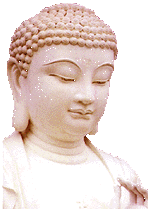
- MIND LIKE DAWN
By Nhat Quan
-
---o0o---
-
In daily life,
you have to face many stressful problems, and stress is always
a barrier that makes it difficult for you to do your work. In
the rush, you can pass by moments like this:
-
- Maybe
because the family of nine or ten people lives, while there is
only one toilet, so you have to rush each other all morning.
-
- Maybe
because you like to sleep late, so you only have enough time
to drive to the bus stop, or share a car with other friends.
-
- And many
other problems
-
These urgent
needs can take up a lot of quiet time in your morning, rob you
of the private moments of your routine, and push you into a
workday full of rush and anxiety. Therefore, there are times
when you feel confused, as if driving a car without brakes,
running desperately, and praying to God to get through
dangerous turns. You are always rushing to get somewhere,
always busy like a firefighter, dealing with emergencies,
anticipating what will happen next, and rushing to meet
deadlines. Such a hurried pace makes you lose control of
yourself, numbs you to work. And such daily work never ends.
-
If you observe
that busyness, you will see that it is like an anesthetic that
numbs you from feeling the present moment. Meanwhile, the time
of the day ahead can give you many other heavy
responsibilities, such as:
-
- Running an
organization,
-
-
Communicating in the marketplace….
-
And you may
have certain jobs to complete, such as healing a broken heart
or a damaged bridge. So many times, you also lament at the end
of the day:
-
- What
happened? I just went through a day of work, and I don't know
anything about it!
-
Meanwhile, if
you know the saying:
-
- Don't let
work take away your peace of mind
-
And know that
applying the movement of the universe in the first days of a
new year, as well as in the early morning, will make things
different. If there is a time when you hope for a new year to
be as positive as possible, the beginning of a new day is
similar. A new day at dawn is a whole vitality that awakens
after a night of rest. This vitality urges you to slow down,
to relax even for a moment before you start all the work in a
new day. At that time, it's just you and you, so be kind to
yourself in some simple way. You can stop everything and live
right now, and here. Knowing how to stop and be aware of the
privacy of morning habits means experiencing who you are in
the stillness of dawn. And right here, in the morning, you
will start everything in a new day.
-
Because every
morning always brings most of you quiet moments before
starting a new day, the time that nature gives you to feel the
pulse of life and contemplate a working day in twenty-four
hours. In the quiet of the early morning, you naturally feel
very relaxed. Only in that moment, you can let your life be
clear, such as:
-
- Take a
shower, change clothes,
-
- Sit down and
sip a cup of tea, then go to work …
-
All of those
things are simple, quiet, gentle, and refreshing habits. You
are alone in those moments, no matter how short, just you and
life.
-
Knowing how to
welcome the privacy of morning habits is an encouragement for
you to accept the invitation of the morning to prolong the
quiet moment and let the gentle space shine into life. You can
think of morning routines as a daily practice, a crucial time
for peaceful contemplation, like the dawn.
-
In Zen life,
at 4:00 every morning, in Buddhist temples all over the world,
in the Buddhist shrines, the lamps and incense on the altar
are always lit. Tea is offered, a new day begins:
-
- Some people practice with a session of the Shurangama Sutra
in the morning,
-
- Some people practice meditation.
-
- Some people recite the Heart Sutra,
-
- Japanese Zen masters start their day at 4 am, meditating and
having breakfast quietly over their bowls.
-
Whether you choose to meditate every morning, or recite
Buddha's name, or drink a cup of coffee mindfully, or start
the day with gentle activities, with the intention of enjoying
life, these are perfect acts of kindness.
-
Knowing how to joyfully welcome the privacy of your morning
routine, you begin the day with a basic confidence:
-
- That you are completely comfortable with being yourself.
-
A morning with such quiet routines can make you feel genuine,
simple, quietly awake, and refreshed. It is privacy that you
cherish. You are content with who you are for a brief moment,
completely confident in yourself. You don't have to rush
through those quiet moments, nor do you have to rush through
your breakfast or worry about anything.
-
If you don't know how to practice staying in the dawn, then
even if you meditate, of course, you will face the same
restless mind that you sit and observe:
-
- The mind doesn't stop thinking,
-
- The mind wants to go somewhere else,
-
- The mind is restless and wants to be entertained.
-
But if you know how to practice the quiet of a dawn, you will
bring your attention back to the present moment. When you are
mindful of the restless mind, you can be awake. When you
meditate, you can easily take note of the haste and
restlessness, and remind yourself to let go of everything to
be present in the present moment gently. Just by mindfully
observing the speed, you can say that you are stepping on the
brake of time, in the moment you notice where you are. Only
then will you know your restlessness. You will see that you
are the creator of that speed, not the victim of an
uncontrollable task. There are many ways to help you notice
and slow down:
-
- Practice mindfulness in idle moments,
-
- Be open and kind to yourself, and even cultivate the art of
conversation.
-
- Take a sip of water, or offer it to someone else,
-
- Stop to take a deep breath, and smile at your own haste.
-
These can help you effectively slow down your work. By
repeating these behaviors, you will discover that your work is
not uncontrollable. Doing so means that you are fully equipped
with brakes to slow you down, a horn to warn others, lights to
guide you, and mirrors to check. Gradually, you discover that
instead of being reckless, even under pressure in your daily
work, you can still have the courage to overcome any deadlock,
as long as you know where you are and what to do.
-
Some of you can take note and slow down your work. Observing
and slowing down your haste helps you:
-
- Filter impulsiveness and harm from clarity,
-
- Filter panic from confidence.
-
As you learn to stop more and more in the midst of the hustle
and bustle, you are more likely to complete the work and not
fall victim to haste than you are truly with the virtues:
-
- Carefulness rather than haste to get things done,
-
- Clear dialogue rather than rushing to express your opinion,
-
- Effective preparation rather than thoughtless habits.
-
With these qualities, even in the midst of the hustle and
bustle of work and speed, you can develop the self-reliance to
rely more and more on yourself. Observing and slowing down
your work does not mean you are running away from reality, but
you are being mindful in the hustle and bustle of work
situations. Even when the pressures of work are high, you can
still stop and be mindful in that moment, so that it can wake
you up rather than lull you to sleep.
-
Studying
Buddhism is to awaken you, which also means adjusting your
personality from ordinary to Saint, from a sentient being to a
Buddha. That is the path that the Buddha has gone through, the
Sravakas, Pratyekabuddhas, and Bodhisattvas are practicing,
and you are starting that journey to reach Buddhahood.
-
The difference
between Buddha and sentient beings is that Buddha is
enlightened, while sentient beings are deluded; while
everyone's seven-element material body, six senses, and six
objects are also the same. Therefore, between you and Buddha,
between Pure Land and Saha is the same, no difference. And
also because of not understanding, you think that having
enough money and position is happiness. Therefore, many people
always seek wealth, beauty, fame, food, and sleep, but if you
do not have them, you will suffer; Buddha calls that
ignorance.
-
Buddha or
Arhat, whether in heaven or hell, their mind remains the same
and unmoving, meaning that the circumstances are different,
but the mind does not change. Thanks to the Buddha's
completely pure and unwavering mind, he transformed the Avici
Hell into the Pure Land. That is the process that the Buddha
experienced and achieved, and the Bodhisattvas and Saints are
practicing.
-
Following the
Buddha's footsteps, you see what causes the haste, anxiety,
fear, and suffering. In today's terms, it is pressure or
stress in life. Many times, you see rich countries like
America, but the people there feel that life is too tight and
too heavy. While the poorest people are nowhere near as poor
as the poor in Mexico or Vietnam, they are very peaceful and
liberated; in other words, they have understood the teachings
of Buddhism and can apply them in life. On a day, they earn
only one or two thousand pesos or a few tens of thousands of
Vietnamese dollars. Or in India, a janitor earns about 1 USD a
day but can support his family and live in peace. It is clear
that their status and money are at the lowest level in
society, but they are not pressured in life.
-
Why are you
pressured in life? Buddha taught that you are pressured in
life because you have too much:
-
- Greed,
anger, ignorance.
-
Because of
ignorance's guidance, that is, wrong decisions that guide your
greed, you will end up in suffering, the root of which is the
ten things that bind you, which are:
-
- Greed,
anger, ignorance, arrogance, doubt, self-view, extreme views,
wrong views, attachment to views, attachment to precepts and
prohibitions.
-
Buddhist
practitioners must break the bondage and first need to break
the greedy mind. Indeed, the solid prison is built by your
greed. You suffer because of greed, and are pressured in life
because of greed. Those who are greedy for fame, wealth, and
love, the more greedy, the more suffering. In the sutras, it
is recorded that once the Buddha and the Holy Ones met a
plantation owner who had lost his cow. He ran to find the cows
until he lost his appetite and sleep. Therefore, Buddha said:
-
- The Bhikkhus
are happier because they do not have plantations, do not have
property, so they are not bound by it.
-
The reality of
life shows that business people are in decline, in debt,
bankrupt, and even imprisoned. This tragedy comes from
ignorance and greed. Because of too much greed, you become
confused and make wrong decisions. Greed and ignorance
interact with each other. Some people ask friends for help
because their debts are piled up to their heads. You are not
in debt, but you want to be a billionaire to show off to the
world, so you borrow up to your heads, with no room to
breathe. Because you do not pay the debt, the creditor is
looking for you, so you have to hide. You live under such
heavy pressure, but how can you escape? Maybe the creditor
cannot find you, cannot collect the debt, but the hell of the
soul, the hell of the conscience is more frightening, from
this life to the next, when it fills the mind, how can you
live peacefully? That's why Buddha said:
-
- Hell is very
solid.
-
That means:
-
- Layers on
top of each other.
-
Indeed, at
first you have no debt, then a little, until you have a lot.
At first, no one hates you. Then a few people hate you, and
soon many people boycott you. How can you live? Such a
miserable life is a hell created by your own greed, and you go
there yourself and live in it. Somewhere on Facebook, there is
a record of a Mexican man who fishes a few fish a day, but can
support his family and live comfortably. He does not practice
religion, but eats one meal a day; on days when he has no
money, he eats one meal every two days. You may be scared when
you hear that, but for Mexicans, they only need one or two
tortillas to put red beans in and still live peacefully;
clearly, they are not pressured in life.
-
You see some
scary drivers in Vietnam. The light is red, but some people
still drive and cross it. Perhaps these people are under
pressure in life, pressure at work, forgetting their lives,
forgetting their families. You feel sorry for them. Perhaps
these people have difficulties in life, so they need work and
ignore the red light, meaning they ignore accidents that can
kill or injure, but they do not think about how many people in
their families will be affected by the accidents.
-
Remember, in
1975 and 1976, there was a shortage of means, but people still
lived. But now, with all the means, they are still under
pressure. Buddhists should think and know how to stop, why,
and in the past, when they did not have much money, they could
live. To reduce the pressure in your life, the best way is to
apply the Buddha's teachings, do not do what is beyond your
means, or you will suffer, and it will bind you forever.
-
Buddha taught
that the ten things that bind you, that block you from seeing
clearly, you must remove them yourself. One of the bonds is
greed that blinds your eyes and darkens your mind. The origin
of ignorance is greed. There are many things in greed, but
when you put them together, there are three basic things. If
you cut off one, you will lighten it. The three kinds of greed
are:
-
- Greed for
fame,
-
- Greed for
profit, and
-
- Greed for
love.
-
If you are
obsessed with fame, you will be bound by fame, making you
think you must have fame, and when you have fame, you will
think you must have profit, and the next urge is love. That is
the process of you drowning in this life.
-
Indeed, when
you are young, you always think about fame. There are two
kinds of fame:
-
- False fame
and
-
- Real fame.
-
You should
avoid false fame because chasing after false fame and
embracing fake fame will not get you anything. If you want to
have real fame, you must train yourself to have knowledge and
morality. Therefore, Zen Master Wu-de said:
-
- In the midst
of life, the mind is pure and clean,
-
The principle
is like that. Your living environment is like water in a vase;
you are the flower. If you want the water in the vase not to
rot, you must always check the flowers. Likewise, if you want
the common living environment not to disturb you, you must
constantly purify your body and mind, change your temperament,
constantly examine yourself, correct bad habits and
shortcomings, eliminate worries, and then you can absorb the
essence of nature.
-
Just put aside
delusions, get rid of distracting thoughts, and then you will
be calm wherever you are. The reflection of calm water is the
image of a calm mind. A calm mind is one mind is not disturbed
by mental factors such as anger, jealousy, fear, and anxiety.
Just imagine a still lake on the mountain, reflecting the
clouds and the mountain peaks so clearly that you can take
pictures of the clouds and the mountain peaks when you point
the lens at the lake.
-
If your mind
is calm, you can also reflect the truth honestly, without
haste, without distorting the truth. However, this requires a
wise master to be able to train a good disciple, and for
ordinary people, it is impossible to guide you. Once you have
created good habits, your life will have rules and direction.
But remember not to let work take away the peace of mind, the
importance of self-control, and your health, both physical and
mental, is important. The attitude of sharing and giving, and
at the same time finding the answer to the question of what a
good and happy life is, will not be difficult.
-
Life will also
become meaningless if you cannot find the quality and meaning
of the present moment. Living happily is a skill that needs to
be practiced, and this skill comes from meditation and the
positive response of each individual in work and life.
Meditation will definitely bring you results and significant
changes.
-
Mindfulness contributes to the stable development of the
world. Therefore, you need to create for yourself a calm,
leisurely environment, listen to each other more, and care
more about the community to develop a meaningful living
environment for yourself and everyone on a normal day. For
example, today is a normal Saturday. If so, it means you are
happy, enjoying a peaceful weekend. A normal day is a day that
is not unusual; the mind is not disturbed by anything. You do
not need to do anything big on a normal day. Just wake up
early, meditate for a few minutes, quietly burn an incense
stick, ring the bell three times, and then read a short sutra.
Or you can skip the meditation time, sleep a little longer,
then bow to Buddha or go for a walk in the park to exercise in
the morning. Yet many of you keep looking for days that are
called extraordinary, even abnormal, and then return tired and
stressed. At that time, the body and mind cannot sleep
peacefully, struggling, worried, and uneasy. Many times. It
seems that most of the days are like that, work, life worries,
children, spouses, everything seems to want to sweep you into
the whirlpool of life, forgetting the simple happiness of a
normal day like today.
-
So, it is said that extraordinary or unusual is both
suffering, and normal is true happiness. The happiness of
doing nothing, not wanting to become anything, nor needing to
become anything, but having meaning for you to be you, fully
in every moment in the present. You wash dishes in peace, cook
mindfully, go to the market in peace, and talk in awareness.
What could be more wonderful than that!
-
A day without a rush is as peaceful as the dawn, and a normal
day is a happy day. A person is happy because that person is a
happy person. Yes, in this moment, a happy person is a normal
person with a peaceful state of mind, like that!
-
All of you should try to do this, when you open your eyes
every morning, in the morning sunlight, smile and thank life
for giving you another new day. Then you will see another
meaningful day coming to you, even though there are many
unexpected things that do not go as expected. But if you know
that you are living to experience those things, both happy and
sad, then you will be very grateful to life.
-
In short, when you are a learned person living in a modern,
fast-paced, vibrant, and challenging society, you are no
longer unfamiliar with the terms stress and fatigue. These
things come naturally with the pressure of work, study, exams,
and life goals that you cannot avoid. The development of
society requires workers to think and work to the point of
exhaustion, while students are caught up in the whirlpool of a
huge amount of knowledge, so stress and fatigue will knock on
your door immediately. Rushing and fatigue occurring
frequently have extremely serious effects on health and reduce
the quality of life. Stress and fatigue will seriously reduce
work efficiency, memory loss, increase the risk of errors at
work and in exams, and reduce academic results. More
seriously, if not resolved, stress and fatigue will exhaust
you both mentally and physically, causing anxiety, loss of
concentration, loss of attention, loss of confidence, loss of
motivation to work and study, leading to feelings of
disappointment, depression, and illness. Thus, success is
difficult to achieve if you are always in a state of rush,
stress, anxiety, and fatigue. Therefore, when there are signs
of stress and fatigue, learn how to relieve them by relaxing,
resting, and increasing exercise... Work pressure, study
pressure, high work intensity, worries, and calculations cause
the mind to be exhausted, leading to loss of appetite and
sleep, nervous disorders, and exhaustion of both mind and
body.
-
Therefore, a healthy mind will give you a strong spirit, peace
of mind, a powerful motivation, and clear intelligence to work
and study. Fatigue happens to anyone when they are always
facing the risk of being overloaded in work, study, and
business relationships. The problem is what each individual
must do to relieve it by learning how to relax, rest,
strengthen the body, and at the same time solve their mental
illness with the principle:
-
- Keep the mind calm, full of vitality, and bright as the
morning sun.
-
- Do not let work take away the peace of mind.
---o0o---
If you have any recommendations,
please e-mail to:
chuaduocsu@duocsu.org
|
|