-
In Buddhist tradition, the original and first healer is the
Buddha. Often called the Medicine Buddha, it was the
Medicine Buddha who revealed the sacred teachings
encapsulated in the scriptures known as the Four Medical
Tantras. All Buddhist medicine originates from this sacred
collection of scriptures.
-
The Medicine Buddha is the ruler of the Lapis Lazuli Pure
Land in the East, also known as the Vajra Buddha. Offering
to the Medicine Buddha can cure hundreds of diseases and
eliminate the root causes of suffering.
-
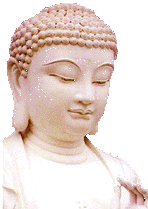
He has one face, two hands, and a body of lapis lazuli
color. The Medicine Buddha sits in the Vajra posture, on a
lotus throne. He possesses 32 auspicious marks and 80
beautiful features. He wears three robes of liberation. His
right hand, in the gesture of giving, holds medicinal herbs;
With his left hand open, he holds a bowl containing divine
medicine, which he uses to eradicate countless ailments and
sufferings, fulfilling all the wishes of sentient beings. To
his left is the Bodhisattva Sunlight, and to his right is
the Bodhisattva Moonlight. The Medicine Buddha made twelve
great vows to save all sentient beings from their
sufferings. The true nature of these illnesses and
sufferings stems from fundamental ignorance. He helps
sentient beings escape the cycle of birth and death; he is
revered as the Great Medicine King Buddha or the King of
Goodness. Practicing the mantra of the Medicine Buddha can
eliminate all incurable diseases of the body and mind, root
afflictions, and accomplish worldly good deeds and
transcendental Buddhist practices.
-
Once, the Medicine Buddha sat in meditation, surrounded by
his disciples, including physicians, wise men, celestial
kings, and Bodhisattvas, all wishing to learn about his
healing methods. They were all silent, captivated by the
Buddha's radiant and majestic aura, and dared not speak.
Knowing their aspirations, the Medicine Buddha emitted two
rays of light:
-
- The first ray of light was a request to learn the Dharma,
-
- And the second ray of light explained this Dharma.
-
Thus, this sutra was spoken, and the Medicine Buddha
explained various physical and mental illnesses, their
causes, diagnoses, and treatments. Furthermore, the Buddha
understood the aspirations of his disciples without them
having to express them. This demonstrates the Buddha's
boundless compassion for his disciples.
-
Healers like the Buddha are called great physicians, not
only because of their ability to heal but also because of
their compassion and wisdom to diagnose and treat the root
cause of the illness, whether physical or mental. Therefore,
in art, the image of the Medicine Buddha is depicted in
golden yellow, although other features remain blue. In every
image, the Medicine Buddha's left hand rests on his thigh in
a meditative mudra, holding an iron bowl. His right hand is
open, as if bestowing a gesture of generosity, and a willow
branch in Vietnamese, myrobalan, a Tibetan medicinal herb.
This is a very common medicinal fruit in Tibetan medicine,
and here symbolizes the powerful regeneration of the plant
world.
-
However, Buddhist medicine not only applies medicine to
treat the external symptoms of illness, but also uses
spiritual practice and enlightenment to heal the root cause
of human ailments, and each of us can heal ourselves in this
way. Therefore, the Medicine Buddha is often depicted
surrounded by various fragrant medicinal herbs, in Tibetan
medicine, with countless celestial kings and Bodhisattvas.
This drawing is called:
-
- The Eastern Pure Land
-
This Pure Land symbolizes an ideal universe where all the
remedies for every ailment exist. The Medicine Buddha also
said:
-
- Every sentient being existing in the world system has a
path to liberation.
-
It was because of this conviction that a fashion and beauty
consultant was diagnosed with cancer. Upon learning of her
cancer, she sent a message to a friend studying at the
Vajrapani Institute in California, asking about healing
practices. Her friend advised her to buy animals about to be
killed and release them in a safe place, allowing them to
live longer. This kind and absolutely faithful woman saved
many animals from slaughter. She released two or three
thousand animals, mostly chickens, fish, and earthworms. She
took the chickens to a livestock farm and released the fish
into the river. She bought two thousand earthworms because
they were cheap and easy to find, and she released them in
her garden.
-
Releasing earthworms is a very good idea because when
released, they quickly burrow into the ground. Living in the
garden, they are not killed by other creatures and thus live
longer. Other animals released into forests, lakes, or seas
are not guaranteed to live longer because they always have
natural enemies. It is said that after practicing animal
release for a while, she felt better, then went to the
hospital for a check-up, and the doctors found no trace of
cancer.
-
Whether true or false, this is not surprising to those who
believe in the law of karma. These are the words of the
venerable monks:
-
- No debt in the universe does not have to be paid. The
universe has a very perfect system of accounting, and
everything is an exchange.
-
When her body recovered from illness and her mind became
healthy through the path of animal release, and by helping
the lives of weak animals, the woman affirmed her belief in
the truth of the law of karma:
-
- Karma is both the action and the result of that action.
-
Thus, her actions were not magic or miracles, but rather the
sowing of appropriate seeds that would bear fruit in the
form of health and happiness. Indeed, if you want to create
happiness in your life, you must learn to sow seeds of
happiness for others. Just as the practice of ordinary
Buddhists teaches you:
-
- The results a person receives are the karma of the past.
Everything happening right now is the result of actions you
have taken before. This is an illustration of the proverb:
-
- You reap what you sow.
-
If you have compassion and kindness, you will always avoid
harming others, and this in itself is a form of healing.
According to Buddhist belief, a compassionate person is the
most miraculous healer, not only healing their own illnesses
or solving their own problems, but also healing others.
Therefore, there is a saying among people:
-
- A good doctor is like a loving mother.
-
Therefore, most people agree that in hospitals, where
disease is rampant and patients are suffering, with the
friendly smile and encouraging words of the doctor, the
patient will feel less pain and recover faster. In fact, it
is compassion that heals the disease. Once compassion
radiates from the depths of a person's heart, it is this
love that creates good health. According to the venerable
monks:
-
- The Medicine Buddha is the spiritual pharmacist.
-
Discovering the latent healing power within yourself is the
path to the pure land of the master of antidotes.
Furthermore, through practice, your body has the ability to
heal itself of any disease. Because each plant, each herb,
each antidote has its complement within the subtle core of
the human body. You not only have the ability to heal
yourself, but also to heal those around you. Because a
person with a compassionate heart, who cares about life and
vows to practice the Medicine Buddha Dharma, becomes someone
with extraordinary healing abilities. This ability is only
achieved when you accept sacrificing your private life,
worrying about the suffering of others, enduring suffering
like others, and feeling their pain. Cultivating these
feelings of empathy will increase compassion and pity. Only
in this way can you mobilize the unlimited healing power
hidden deep within your boundless consciousness. There is a
story about a Zen abbot who attained healing power through
compassion. One day, while he was teaching his disciples, he
suddenly cried out:
-
- Ouch, it hurts so much!
-
When his disciples asked him what was wrong, he said that a
dog was being beaten outside the temple gate. When they went
outside, they saw an angry man beating a dog with a stick.
When the man was called inside the monastery, the abbot
pulled down his robe to show him the bruises and cuts on his
back, exactly where the dog had been beaten. This is the
unifying quality that an ideal healer should possess.
Buddhist tradition identifies the Medicine Buddha as the
ideal healer and emphasizes that the most powerful healing
power lies within you.
-
The path to liberation must go through practice, especially
meditation. By meditating and visualizing the Medicine
Buddha before you, you can face the Medicine Buddha and see
his radiant, compassionate smile towards the universe and
his gentle eyes filled with loving-kindness towards all
beings. Next, from the heart of the Buddha, a brilliant
radiance emanates, and this light gently permeates your
heart. The heart here signifies the essence of nature,
located deep within your chest, not merely a physical
machine that pumps blood. This core is defined as follows:
-
- Within yourself, there is stillness and a sacred sanctuary
where you can retreat at any time to practice prayer and
quiet solitude.
-
This sacred sanctuary is the simple awareness of comfort,
undisturbed by any disturbance. There is no fear and no
suffering. A practitioner needs to find this mental space to
heal their ailments. This is not through words or
linguistics. It is a truly unexpected feeling, a free
understanding, where you experience truth without words.
Truth filtered through words is constrained because you need
a certain amount of time to focus on its meaning. Through
symbolic experience and spiritual creation, ordinary beings
like you are transformed into outstanding healers. This is
how you communicate with the Medicine Buddha, the greatest
physician.
-
Therefore, physicians, especially those who have faith in
Buddhism and believe in the above ideals, practice the
Medicine Buddha method and invoke the Medicine Buddha before
prescribing medicine, prescribing medication, or giving it
to patients, reciting the Medicine Buddha's mantra. The
mantra, in its long form, is:
-
Namo bhagavate bhaiśajyaguru vaidūryaprabharājāya
tathāgatāya arhate samyaksambuddhāya tadyathā: oṃ bhaiśajye
bhaiśajye bhaiśajya-samudgate svāhā.
-
This mantra is taken from the Sutra of the Medicine Buddha,
Lapis Lazuli Light Tathagata's Original Vows and Merits.
According to the sutra, Shakyamuni Buddha said that if one
recites this mantra 108 times with pure water and then
drinks it, all illnesses will be cured immediately.
-
Furthermore, those who recite this mantra throughout their
lives will be cured of illnesses and live long lives, and
upon death will be reborn in the Pure Land of Lapis Lazuli.
However, it should be known that this mantra is called the
Consecration Mantra because it was spoken from the Buddha's
crown of light. Whoever recites this mantra and purifies
their three karmas, body, speech, and mind, will have the
Buddha's light shine upon their crown, refreshing them like
the pouring of nectar.
-
Know that the Buddha's light is different from the light of
demons. The light of demons is dazzling and frightening,
while the Buddha's light is cool and joyful. Therefore,
whoever recites this mantra or chants the Buddha's name must
clearly distinguish between these two kinds of light. Do not
mistake the flickering light of demons before your eyes,
like a non-believer looking at a candle or incense stick,
for seeing the true nature of reality.
-
This symbolic action points to the practice and the sacred
energies that created the mantra, giving the medicine its
healing power. Similarly, by consciously walking the right
path of karma, you can imbue your life with nectar flowing
from good actions through the cultivation of virtue.
-
In the practice of the Medicine Buddha Dharma, venerable
monks recite mantras during their sessions to eliminate
karmic obstacles and increase blessings. As has been
mentioned before. The meaning of the word "Mantra" is the
secret language of the Buddhas, called Secret Language or
Buddha Language. This special language is only heard and
understood by the Buddhas in the ten directions; it is not
the ordinary language used by sentient beings in the three
realms. Therefore, ordinary people cannot fully understand
this language. Those who wish for the blessings of the
Buddhas and Bodhisattvas in the ten directions only need to
practice the instructed mantras to receive their wishes.
Esoteric Buddhism has many types of mantras, each with its
own purpose, but usually only a few are chosen for
recitation in ceremonies such as prayers for peace, prayers
for the deceased, repentance, etc. These include the
Shurangama Mantra, the Great Compassion Mantra, and ten
other mantras called the Ten Mantras. The meaning and
purpose of these mantras may be related to specific
historical factors or archetypal deities, or they may not be
related to these things. Examples
-
Mantras associated with the historical Buddha are:
-
- Om muni muni mahamuni Shakyamuni svaha,
-
Mantras associated with the deity Avalokiteśvara Bodhisattva
are:
-
- Om mani padme hum,
-
Or:
-
Mantras containing Prajnaparamita, which is associated not
only with an enlightened being but also with a famous sutra,
the Prajnaparamita Sutra, that is, perfect wisdom, are:
-
- Gate gate paragate parasamgate bodhi svaha
-
Mantras are powerful single syllables or sequences of
sounds. These sounds contain a series of sound waves and
energy. When recited, mantras not only help to eliminate
illness, afflictions, and karmic obstacles but also have the
power to connect and unite our minds with higher levels of
consciousness. Thus, mantras are the direct key to revealing
the outer and inner universe, a quick, gentle, and effective
tool for accessing sacred energies from higher dimensions of
consciousness. The power of a mantra depends on your state
of practice and inner realization, and especially on the
guidance and instruction from an enlightened spiritual
master.
-
Mantras are a combination of sacred seed syllables that emit
positive spiritual energies; therefore, they are not prayers
but the profound essence of reality, so sometimes you recite
them as if chanting. In Sanskrit, Mantra is a compound word:
-
- Man means thought.
-
While the word:
-
- Tra means liberating oneself from the material world.
-
The combination of these two words creates Mantra, meaning
the mind is liberated and protected, also known as the
Protection of the Mind.
-
Secret and sacred mantras express fundamental sounds and
energy essences to bring about harmony between body and
mind. Chanting a mantra brings extraordinary healing energy
and helps you achieve balance between body and spirit, just
as food nourishes the body, so too does the mantra nourish
and heal the soul. In this way, mantras are powerful
spiritual support; they are not just conventional sounds but
a resonance of subtle, primordial energies already present
within each of you. When you chant a mantra, the sound waves
resonate, emitting gentle healing energies throughout your
body and mind. From a spiritual perspective, mantras are a
means of communication, connecting Buddhas and Bodhisattvas
with sentient beings to purify karma and bring about
enlightenment for all living beings
-
In terms of method, generally, when you first begin reciting
a mantra, you should recite it to clearly hear the sound you
are reciting, so that the sound waves of the mantra spread
deeper into your heart, and ultimately, you can abide in
tranquility, allowing the inner transcendental sound to
silently operate within yourself. From a practical
standpoint, this is extremely important. Therefore,
venerable masters often teach that there are some mantras
that you must recite silently within yourself. However,
there are some mantras that are not permitted to be recited
without receiving empowerment or oral transmission from a
master who has practiced them. In this case, you need to
receive formal guidance on how to use the mantra. The reason
why spiritual masters need to transmit mantras to their
disciples is that when an enlightened master recites and
transmits mantras orally to their disciples, it is also a
continuous transmission of blessings and grace, enabling the
disciples to have the ability to continue practicing the
mantra and achieve enlightenment. As a result, the power and
merit of mantra practice will grow exponentially.
-
In Buddhist practice, many things can be used as objects of
meditation, such as breath used for mindfulness, awareness
while walking used for walking meditation, emotions used for
concentration in developing compassion, and visualization of
images and objects used in contemplative meditation.
-
Today, countless people are admitted to hospitals every day,
awaiting emergency treatment, many of them very young, some
even unmarried. Their fortunes, careers, wealth, and
possessions are gradually lost, and most are left with
lasting disabilities; some are bedridden, suffering until
death. Only a few, with rare luck and merit, recover even a
small percentage.
-
In the past, cancer was rarely heard of. Even when it did
occur, it was very rare, affecting only the elderly. Today,
if you go to the Oncology Center, you'll find wards and
departments packed with patients suffering from all kinds of
diseases: Leukemia, brain and spinal cord cancer, laryngeal
cancer, lung cancer, liver cancer, colon cancer, stomach
cancer, breast cancer, uterine cancer, ovarian cancer,
prostate cancer, spinal tuberculosis, bone cancer, etc.,
etc.
-
Not only the elderly but also newborn babies and teenagers
are affected. They endure so much pain through repeated
surgeries to remove tumors and cells from their bodies, but
ultimately, they don't live much longer. In addition,
humanity today is also plagued by the HIV-AIDS pandemic,
Hepatitis B and C viruses, Japanese encephalitis, diabetes,
and heart disease. That's in the human world; among animals,
there are epidemics like mad cow disease, foot-and-mouth
disease, and swine flu. Poultry and birds are facing life
and death due to the H5N1 pandemic, and humans are suffering
from many other diseases that cost a fortune. Even with the
right doctors and medicine, repeated treatments fail to cure
the illness. This is because sentient beings are paying the
karmic consequences of evil deeds committed in past lives.
So what should you do now?
-
Calm your mind and reflect on cultivating your three karmas:
-
- Body, speech, and mind
-
Be kind, upright, and pure. Do many good deeds and avoid
evil. Have deep faith in karma, meaning that evil deeds will
result in evil consequences, and good deeds will result in
good consequences. If there are no consequences in this
life, there will be in the next. Therefore, repent and atone
for past mistakes, worship the Medicine Buddha, and always
recite:
-
- Namo Medicine Buddha, the King of Lapis Lazuli Light
-
If possible, you should always recite the Buddha's name and
mantra from memory. Every day and night, no matter what you
are doing, whether walking, standing, sitting, or lying
down, recite the name of the Medicine Buddha and the mantra
above, and after drinking the medicine, the Medicine Buddha
will secretly bless you, making the medicine more effective,
your illnesses will gradually improve, your merits and
wisdom will increase, your lifespan will be extended, and
you will be spared from harm.
-
The reason why reciting the name of the Medicine Buddha
brings miraculous results and benefits is that the
aspirations of all Buddhas in general, and the Medicine
Buddha in particular, are to save sentient beings.
Therefore, when sentient beings remember them, they provide
unconditional protection, hence the saying:
-
- "Where there is a request, there is a response."
-
Similarly, radio and television stations have widespread
coverage; if you want to turn on a radio or TV channel, that
frequency will respond to your wishes. Similarly,
spiritually, if you have a sincere aspiration towards a
particular Saint, the grace of that Saint will respond to
your devotion. If you are suffering from illness and have a
sincere aspiration directed towards:
-
- "Namo Medicine Buddha, who dispels calamities and prolongs
life,"
-
Then the Medicine Buddha will miraculously radiate divine
power to save you, avert misfortune, and eliminate karmic
obstacles. After leaving this temporary physical body, if
you wish to go to the Medicine Buddha Pure Land, you can. If
you don't wish to go to the Medicine Buddha Pure Land and
instead wish to go to the Western Pure Land, eight Great
Bodhisattvas will directly guide you there.
-
In short, the Medicine Buddha Pure Land is certainly no less
superior than the Amitabha Pure Land. The Eastern Pure Land
is also extremely excellent, an ideal place to pray for
rebirth. A special feature is that the method of praying for
rebirth in the Eastern Pure Land is reciting the Medicine
Buddha mantra.
-
The Medicine Buddha has a connection and closeness to the
Saha world. He is the Supreme Physician, compassionate and
merciful to all beings suffering from illness. Therefore,
all sick people should pray to him, and so should those
caring for the sick. Doctors, if they believe in and pray to
the Medicine Buddha, will receive his blessings for
extremely effective treatment. Besides focusing on treating
illnesses, the Medicine Buddha also cares for the poor,
those lacking food, clothing, and material necessities.
Therefore, all acts of charity and humanitarianism in this
life are within the vow of the Medicine Buddha. You can all
pray to Him.
-
Practicing the Medicine Buddha Dharma means doing charity
work in the present, dedicating the merits of reciting the
Medicine Buddha Sutra, chanting the Medicine Buddha's name,
and reciting the Medicine Buddha mantra to pray for rebirth
in the Eastern Pure Land and dedicating the merits to the
poor, the sick, and all sentient beings in the Dharma realm;
telling people about the Medicine Buddha, the miraculous
aspects of the sutra, name, and mantra.
-
Regardless of which Dharma you practice, you can pray to the
Medicine Buddha to have fewer illnesses, less suffering, and
favorable conditions for cultivation. Once you have
cultivated, there are many ways to resolve karmic obstacles.
The Buddha and Bodhisattvas save you, but they don't erase
your karma. You resolve your own karma.