
|
|
DHARMA IN EVERYDAY LIFE
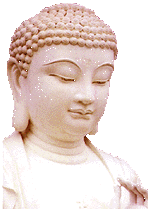
- NEW YEAR,
- NEW OPPORTUNITIES
By Nhat Quan
-
---o0o---
-
Another year
has passed with many changes in the world and among people.
Plants and trees grow, sprout, and then wither and fall
according to the four seasons. We all go through the four
stages of birth, aging, sickness, and death, but everyone
hopes for a brighter tomorrow than today, and a new year with
many new and more favorable opportunities than the previous
year. Therefore, in the last days of the year, no matter where
you are, no matter what the circumstances, you all prepare
materially and spiritually to welcome the New Year. Because
everyone believes that the beginning of a new year is the
starting point for dreams and beliefs, the beginning of action
programs, and also the premise for hopes of success in life
and in the spiritual path. Above all, it is the dream of peace
and happiness, from the external circumstances to the body and
mind inside each person.
-
Indeed, spring
is the season of warm weather, of all things reviving after
the cold, bleak winter months. Spring also makes your heart
soften, expand, blend with the earth and sky, and sympathize
with everyone. For Buddhists, spring is the right time to go
on pilgrimages and visit monasteries. Some of you who are
still focused on blessings go to the temple to pray to Buddha
for health, happiness, and good luck in life. You think of
Buddha as an enlightened being, a place of refuge in your
soul, but also a source of comfort, a precious spiritual
encouragement for a human life.
-
The first days
of the year are also an opportunity for you to visit relatives
and friends, to give each other good wishes, to drink wine
together, a cup of tea, so that the love of fellow countrymen
will have the opportunity to grow, and the feelings between
people will have the opportunity to be more closely connected.
You will find your heart is filled with the earth and sky and
people, and you will know how to live with love for your
fellow countrymen. You also know how to respect and protect
the living environment around you, because all things are
extremely close to you.
-
However, this
is the kind of happiness or joy of the world; the various
forms of entertainment are only temporary, because even the
happiness of reunion will eventually give way to the sadness
of separation. No matter how bustling the New Year days are,
when you return to the worries of everyday life, you will feel
even more lonely and empty. Especially for those who are old
and lonely, when their children and grandchildren leave one by
one, the brief reunion will only exacerbate the sadness and
loneliness in their souls. Even the happiness that Buddhists
experience when they visit the temple only exists when they
can admire the Buddha's face and serene smile, and immerse
themselves in the peaceful atmosphere of the temple. Then,
when they return home, they are again caught in the whirlpool
of existence, again immersed in the mundane world, and bound
by the chains of fame and wealth of the world. Because, in
every joy there is a shadow of suffering, because that joy is
borrowed from the outside, and because it is not lasting, not
sure of reality. Just like the spring of heaven and earth, it
only exists for three months and then, according to the
cyclical law, gives way to the hot summer. Buddhists call it
the joy of birth and death, joy in impermanence.
-
A spring with
a new opportunity has true meaning, and to make joy and
happiness last longer, as a Buddhist, you must also understand
that every time spring comes and the new year comes, in Zen it
is also called Maitreya spring. The reason is that Maitreya's
birthday falls on the first day of the new year. The image of
Maitreya Bodhisattva is plump, with a big belly, a plump and
benevolent face, a comfortable smile with the children
surrounding him, expressing boundless happiness. The children
represent the six senses that always follow him around and
make trouble, just like the worldly scene that is always
present around you. But unlike us, although he still receives
fate, he is not attached, not contaminated. Maitreya
Bodhisattva has a happy smile even though he is surrounded by
six thieves, because he is the Great Joy and Great
Forgiveness. Joy is not joking and laughing as is common in
the world, but is the sincere joy and praise for the success
and happiness of others. Forgiveness is not turning away from
the unfortunate situations of life, but wholeheartedly helping
others without attachment; it is a pure state of mind before
the Dharma and before the ups and downs of life. Knowing how
to let go is the only way to truly love others, to sympathize
and forgive their shortcomings, and to work for the benefit of
living beings.
-
Because of the
great renunciation, the six thieves become the six
supernatural powers, so he always has a complete and eternal
joy, which is Great Joy. This joy is the premise of absolute
happiness, a happiness that liberates from the cycle of birth
and death. With the virtue of renunciation, with an open and
joyful smile, with a full face, a plump body, expressing the
true nature of carefree freedom with the six thieves, he
completely reveals a state of peaceful renunciation; whoever
looks at him will have a joyful mind. Maitreya Buddha
symbolizes boundless and eternal happiness; in him radiates a
peaceful spring sky.
-
Thus, your
true happiness does not come from the outside, but from the
renunciation within yourself. In daily life, you let go of
disputes, unsatisfactory things, seeing them as just rain,
clouds that pass by, and then disappear. At that moment, you
feel somewhat at peace. Taking a step forward, you contemplate
the worldly scene as just a false combination of causes and
conditions; the mind does not start to discriminate when the
senses come into contact with the objects. Knowing that all
ideas are false, step by step, you let go of all attachments
to you. Only by letting go will you realize that Nirvana is
present and not somewhere far away, and Spring with new
opportunities is also right here and now!
-
From this
point of view, you can see that a person with the virtue of
joy and forgiveness is a person with a happy spring sky.
Letting go is letting go without regret, without being
attached to anything, letting go of what has passed, without
being entangled in the mind, resolutely letting go like a
breeze, like an echo, like a swallow flying over a lake, like
a breeze passing through a bamboo branch, like someone who has
wronged you, you let go and forgive, not holding on to blame,
not demanding, not letting the mind hold grudges. Like that,
you and the other person will sympathize and be happy. Thanks
to that, it is easy to create for each other a spring of peace
and true happiness. Therefore, those who, when things like
power, position, fame, and wealth are out of reach, remain
calm and unperturbed, without the slightest regret, truly
demonstrate a free and easy heart, taking fame and love
lightly, like a rose petal falling from the hand to the
ground. Such people are filled with a happy spring, leisurely
and at ease in the midst of a life of suffering and misery.
-
Enlightened
saints see fame, wealth, and love as dust stuck in their eyes,
so they are always comfortable, at ease, and happy in the face
of life's ups and downs, through the advice of the ancients:
-
- Talent and
beauty in the world are nothing more than a drop of dew, like
trees growing on rocks; fame and money harm the spiritual
heart like dust stuck in the eyes.
-
When you know
how to take fame and wealth lightly, despise power and
position, and give up desires. When fame, wealth, and love
fall away, it is like shaking off the dust from your clothes.
You will certainly create for yourself a spring of eternal
happiness and will enjoy the beauty of the endless spring sky.
-
Similarly,
those of you who understand that this body is a temporary
combination, that the existence and disappearance of this body
is like a drop of dew in the morning, will be liberated from
birth and death. This body lives through breath, breathing out
without inhaling is entering another life. Life is fragile
like dew on the tip of a branch in the early morning, like a
rosy cloud at sunset. Today, being happy and together is not
certain to be there tomorrow. The separation from relatives to
become a mortal, the health of the previous moment is hard to
predict the next moment, which is a common thing in the world.
Life changes quickly in an instant. This body is not real, so
money and fame are things you create, outside of your body,
things that depend on you; how can they last?
-
Looking back
at the past years of life, you see that you have experienced
many happy and sad situations, good and bad. When you
encounter favorable and happy situations, you are excited and
proud, but when unfortunate events occur, you are sad and
discouraged, sometimes even blaming heaven and others. A
person who knows how to practice does not expect to always be
lucky and successful in everything, because it can easily make
you arrogant, nor is he afraid of difficulties and obstacles,
because a strong will helps you to progress in your practice.
Realizing that these are obstacles on the path of practice,
but they are also valuable lessons, if you know how to take
this opportunity to re-examine your practice and your
understanding of Buddhism; if you know that delusions and
afflictions are fetters that have long lain dormant in your
consciousness but are false and not real, to practice more
diligently.
-
Thus, you can
turn any situation into an opportunity for inner advancement.
Knowing how to turn obstacles into favorable conditions,
knowing how to take advantage of favorable circumstances to
make your path of practice smoother, you can realize the true
meaning of happiness. Clearly seeing that life is impermanent,
you must also understand its positive meaning, because
impermanence is also the most essential condition to maintain
and develop all things. The heart beats, the blood flows, the
breath goes in and out... are impermanent, but if not, you
cannot exist. If the mind is not impermanent, how can you
transform your mind from evil to good? If karma is not
impermanent, how can you practice to transform bad karma into
good karma? Therefore, Bodhisattvas and sages who realize the
principle of impermanence are people who thoroughly understand
the illusory nature of all things and are not confused and
miserable by impermanence. They do not abandon impermanence,
looking for permanence somewhere far away, but right in the
impermanence, realize the true permanence, from the movement
to live with an eternal, unmoving mind. That is the true
meaning of practice, the eternal youth of the inner mind, a
new opportunity, and also the aspiration of Buddhas and
Bodhisattvas. Therefore, the Buddha taught:
-
- Do not seek
the past, do not wish for the future, reside in the present.
-
Residing in
the present is the content of mindfulness. You often like to
recall happy and sad things that have happened, or dream of a
bright tomorrow, but never know how to be satisfied with the
present situation. Because you are not satisfied with what you
have, you are always suffering and always chasing an unreal
shadow of happiness. People who know the way do not seek peace
from the outside or a happy realm in the future, because
happiness is not the result of searching and chasing, but of
stopping, living fully here and now.
-
Mindfulness is
being aware of every change in the body and mind, inside and
the scenery outside. If at some point you have realized that
spring comes and goes, body, mind, and scenery are all
dependently created, arising, and ceasing in each moment,
while knowledge is always present, never arising and ceasing,
then you must live meaningfully. You are living in an era
where science has made great achievements, so all around you
is a chaotic field of colors and sounds. Without diligent
practice, you can easily get caught up in that chaos, unable
to find peace. Right in the moving machine of all things, you
still calmly meditate; even in difficult circumstances, you
still strive to progress in your practice.
-
Regarding
suffering, you know that it is a necessary material to
stimulate your efforts, because only through suffering can you
find a way to escape suffering. Regarding illness, you know
that life is impermanent, the human body is not permanent,
life is only in a breath, so you do not let time pass in vain.
Before death, you know that it is the beginning of another
life, the end of a life, and the manifestation of new karma in
the next life. Birth, aging, sickness, and death are natural;
only when death comes can there be birth, just as only when
there is a cold winter can there be a warm spring. Creating
the cause of happiness, you are prepared to deal with all
circumstances, even death is not something to be afraid of.
Thus, whatever step of practice has results, you will have
happiness right at that step, because happiness is in the
present and in your own mind and body. The spirit of being
happy in the present is very simple but extremely wonderful
and familiar to everyone.
-
Living in this
world, you must follow the eternal laws of the universe.
Anything that has a form, including your body and life, and
belongings, cannot escape the law of impermanence. Only the
truth is eternal with time and vast with space. Only the truth
is the true refuge of all Buddhists. Even though you go
through the ups and downs of life, if you practice diligently,
you will not be swayed and dragged away. With a peaceful mind,
you will feel at ease anywhere, anytime. With a pure mind, all
dharmas are Buddha realms, the four seasons of the human world
are just eternal spring. The consciousness of body, mind, and
environment is a combination of causes and conditions. Worldly
pleasures are all illusions and not real; you should not seek
happiness from the pleasures of the senses, nor should you
hope for peace from the gods who bestow blessings and curses.
-
When you understand the laws of the universe, you will feel
that the past year is not just to add longevity, or to pray
for new opportunities to have many successes, but as a
Buddhist, you must do something for the religion, for yourself
to increase morality, practice to have more awareness, high
self-control, if so, then a new year, with such opportunities
will be truly worthy. If you have one more year of life, but
live uselessly, meaninglessly, then that spring, although a
new opportunity with many successes, is meaningless to you,
but is also a waste, worthless. Therefore, you must understand
that your life is always lurking under impermanence; it can
capture you at any time. Because of that fragility, it is said
that humans are always facing dangers.
-
Therefore, passing a year is to celebrate being one year
older. But that joy must be combined with your practice and
virtue. That is what Buddhists must try to do, remember and
review themselves, do not let a year pass without any
progress, until the day you close your eyes and still do not
add any good karma, then it is a waste of a life that is
called a Buddhist disciple. Therefore, the Venerables often
say:
-
- A life does not know reciting Buddha's name
-
A human life is so wasted
-
You are a Buddhist; you have chosen for yourself a truly noble
and beautiful path. Thus, you did not abandon all your own
greed, anger, and selfishness, so after a year, you have not
made any progress; your life of practice is still stagnant,
which is your sadness. You must try to make this year, next
year you will rise to be more worthy, do not let it pass in
vain. That is the meaning of new fortune, that is to be happy
to live another year, also happy that you have done good
things for yourself, for everyone in the past year.
-
Hopefully, all of you must clearly see the value of your life.
It is not because you have a high social status or abundant
material means that you are valuable. Value lies in the fact
that your inner self is always bright, and you always share
with everyone. With compassion, you bring enlightenment and
happiness to everyone. Only then will life be meaningful and
valuable. Don't just wander around somewhere for one or two
insignificant reasons, and then your life will pass by in
vain. That is sad. According to the teachings of the
Venerables:
-
- Long or short life is not important, but what is important
is that you know how to use it in all circumstances and
situations.
-
How can you always be mindful and advise everyone to be
conscious? Buddhists are happy with their duties, not living
for the sake of living. People compete with each other, fight
with each other, and resent one another for necessities such
as food, clothing, and shelter. That life is meaningless, even
worse than death. I hope you do not fall into that tragic
situation.
-
Everyone must be aware of the value of their life. Living a
life of study and practice is a moral life, living with
enlightenment, living with compassion, not letting any part of
it decline; only then is it worth living. Living one year with
one opportunity is worth one year; living two years is worth
two years. You should not look down on it and waste your own
value. Many people just let their lives drift away following
fame and profit, not knowing how to improve themselves, not
knowing how to be aware, and even slandering you to abandon
the path of practice, criticizing this nun, condemning that
teacher. Some people are bold enough to criticize Buddhism;
there are people who live meaninglessly, worthlessly.
Hopefully, in this new year, all of you must prepare for each
passing day to be a precious day; do not let it drift away, do
not let the years pass by in vain. Only then will you be
worthy of being a person seeking liberation, seeking
enlightenment.
-
So in this new year and new opportunity, you must promise to
reduce gossip and try to practice more, determined in this one
year to be worthy, practice to get results, so that everyone
believes in you, understands you, and sees your good points.
You want liberation, it does not come to you easily, but it
requires you to have enough ability, enough talent and virtue,
enough language to guide and teach people, then the great work
will be successful. Therefore, you must prepare. Each of you
must see yourself as having the duty to practice and study,
and must work together to contribute to building the place
where you are practicing. You must see that the path of
spreading the Dharma that the master and ancestors built and
expanded is arduous. Now it is you, you have the duty to
continue to preserve and expand it more and more.
-
To do so, your aspiration must be stronger, and your practice
must be more and more diligent. If you let it drift away,
where will the work of maintaining and developing Buddhism
overseas go? You should not entrust the responsibility of
propagating the Dharma to the monks and nuns, and think that
you, as Buddhists, have no responsibility in propagating the
Dharma. If so, your sin is extremely great. Therefore, the
Venerables often kindly remind you to strive to practice and
try to understand thoroughly what the Buddha and the
Patriarchs taught. To increase your spiritual power day by
day, you must look, must see, must sow trust in those around
you. Never look down on yourself, but must examine yourself to
be truly worthy of being a Buddhist. If you can do so, you
will have shouldered the Buddha Dharma with the monks and
nuns. Otherwise, the Buddhas and Patriarchs' dedicated
teachings will be in vain, and in the end, there will be no
significant results. That is where the Venerables hope that
all of you must be aware and prepared so that tomorrow you
will be faithful Buddhists who practice exactly as the Buddhas
and Patriarchs have taught and outlined. Because if the Dharma
that the Buddhas and Patriarchs outlined was wrong, it would
have already disintegrated. But after 2569 years, it still
exists, proving that it is an extremely useful Dharma for
humanity, so you must nurture it and make it grow further. I
firmly believe that if all of you make sincere efforts to
practice, the Buddha's Dharma of liberation guided by the
Vietnamese in this country will be expanded and spread more
widely. Not only will it expand within the Vietnamese
community, but it can also spread to the indigenous people.
-
Buddhism is a religion with a clear origin a solid support
from ancient times until now. You are a disciple of Buddha,
but you do not practice and introduce it to everyone to
practice together; that is a big mistake. You must see the
goodness and beauty of your ancestors. They have practiced and
attained enlightenment; you must apply your practice to
achieve the same results, then teach that goodness and beauty
to your children and grandchildren, to those in society who
want to understand and know about Buddhism in your country.
Only then will the sect be illuminated, and you will be worthy
of being a Buddhist of Vietnamese Buddhism. If you practice
without knowing how far you have practiced, then you are not
qualified to guide anyone. As a Vietnamese monk, nun, or
Buddhist, if someone asks you what Vietnamese Buddhism teaches
or how to practice, you would not know the answer. That is a
great humiliation. The path that the Venerables have prepared
for you to take is a very long and far road; you Buddhists
must try to have enough strength and ability to move forward.
Do not let the career your ancestors built fade away, do not
let grass grow and moss cover it, causing the path of
developing the Dharma to be forgotten by everyone.
-
In short, in a new year with a new opportunity, you must
demonstrate the ability and character of a true Buddhist; you
must make an effort to practice and introduce the Buddha's
teachings to everyone, which is the common responsibility of
Buddhists. I hope all of you must understand, grasp, and
practice it; do not be negligent, and especially do not stand
outside and only contribute criticisms and condemnations like
before.
---o0o---
If you have any recommendations,
please e-mail to:
chuaduocsu@duocsu.org
|
|